

Runestone Newsletter #2
The AFA in August, 2025

Words from the Allsherjargoði
Big thank you to all the amazing Folk at Baldrshof! We all had a fantastic Freyfaxi. This year, I had the honor of ordaining Gyðja Sara Ault as a priestess of the Æsir. We are all tremendously proud of Sara and excited to have her serving in her new capacity.
Starting at Freyfaxi, we have seen a surge of member applications and new apprentices; Joshua Bailey and Jacob Rutledge in Indiana, Taylor Traficanti in Virginia, Jared Davison in Ontario, Brandon Larsen in New York, and Austin Merwald in Wisconsin. There is a palpable momentum that we are experiencing and we have exciting developments to tell you about when the time is right.
Welcome to all our new and returning students as we begin the 4th year of our AFA Ásatrú Academy!
Fall is here and as the air chills and we turn inward, this is a great time to celebrate hearth, home, and family. The veil is thinning and the ancestors are drawing closer. Let us all take full advantage of this special time to share family traditions and to build new ones. As you make time for family, always remember to make time for your AFA family as well. Our families and our Folk are best when we invite the Æsir into all that we do and celebrate WITH them.
Hail the Æsir!
Hail the Folk!
Hail the AFA!
Sacrifice: It's Not Just for Blót

When we enter into the gifting cycle with the Æsir through Blót, it is a powerful and enriching act of devotion. It is said: “Victory is won in the Blót.” As a member of the AFA, you know Victory Never Sleeps. So, how do we bring this act into our daily routine? What better way to give thanks for the gifts of Óðinn, Vili, and Vé than to use those gifts to become the best representation of their creation we can.
Mannaz (ᛗ) teaches us man is the ordinary presence of the divine in Miðgarðr. It is the stave of the “perfected man” — the complete human being; an initiate in Ásatrú. It is called raunabót: “the true or real bettering.” There are many things we can do in our daily life — or more accurately — there are many things we do every day, that we can do better… that we can do with the divine in mind. Some are small, some are large with far reaching ramifications and consequences. Can they be things that benefit you? Of course they can, but intent matters. If your intent is to be more pious in your daily life and to be an extra-ordinary presence of the divine here in Miðgarðr, you are making your routine a ritual.
Big or small, what they all have in common is their impact on your Ørlög. Adding layer after layer to the Well of Urð, increasing your Hamingja to either wield in this life or pass on to your children. This is pleasing to our Holy Æsir and Ásynjur. Making Miðgarðr a better place by making ourselves better Ásatrúar is how we honor the Æsir every day. This is Living Ásatrú.
Be extraordinary!
Days of Remembrance
Prince Hermann of the Cherusci | September 9th
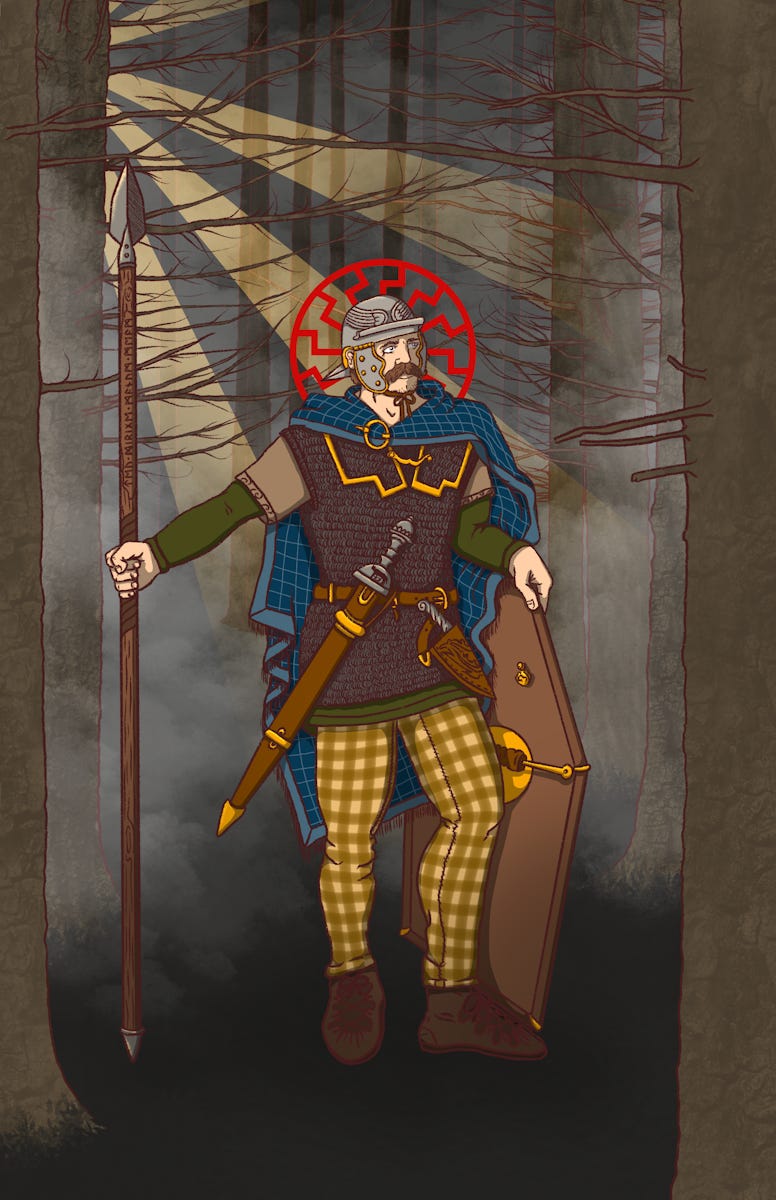
ᛉ 18 BCE - 21 CE ᛦ
Hermann (18 BCE - 21 CE), known as Arminius to the Romans, was the heir to the chiefdom of the Cherusci tribe. The Cherusci were a Germanic tribe that was generally friendly to the Roman Empire but were required to pay tribute in order to maintain peace. Part of this tribute was the sons of local noble families, as was often the case in early European politics. Hermann’s father, Segimer, gave up his two sons — Hermann and his brother — to Roman statesman Publius Quinctillius Varus to be raised in the Roman fashion.
Hermann was given the name Arminius, learned Latin, and was taught the Roman martial discipline that had conquered much of Europe by that point. He was a bright student, a disciplined warrior, and a brilliant leader. His skills were so useful to Rome that they granted him official citizenship, as well as the rank of eques – the equivalent of a knight in the Roman military. He earned this by serving with distinction in the Great Illyrian Revolt. Following this, he was sent home to Germany to aid Governor Varus in conquering the Germanic tribes east of the Rhine.
Arminius, or Hermann, returned to the land of the Cherusci in northern Germany. His people were still there, still practicing Ásatrú, their loyalty to the Æsir stronger than steel.
We do not know exactly why Hermann decided to side with his own people and fight the Romans. Perhaps he had wanted this since he was taken from his father, or perhaps seeing his Folk again stirred something in his soul – we may never know.
What we do know for certain, however, is that Hermann chose to stand with his Folk against encroaching tyranny and globalism. He immediately began plotting a way to unite the various tribes of the area in a bid to push Rome and her legions out of Germany forever.
When an emergency broke out in the Balkans, Governor Varus had to send eight of eleven legions east, leaving Germany with only three to keep the peace. Hermann saw this as a grand opportunity, and likely recognized it as a blessing from the Æsir themselves. He managed to unite many of the local tribes, a seemingly impossible task since they historically had bickered and warred with each other for generations.
In the autumn of 9 CE, Hermann tricked Varus into going to Kalkriese to put down a fake rebellion. When Varus arrived with his three legions, they were quickly swept away and annihilated by the might of Prince Hermann and five Germanic tribes in what is remembered as the Battle of Teutoburg Forest. They united as one people, and became essentially unstoppable. Blessed by the Æsir once again, the Germans had won a victory that would change human history. This battle is seen as Rome’s greatest defeat, as it paved the way for Rome to pull out of Germany permanently. This defeat was so great that Emperor Augustus himself was driven nearly to madness. It is said that he paced around his palace, yelling: “Varus, give me back my legions!”.
After the battle, Prince Hermann’s army proceeded to eliminate every trace of Roman influence east of the Rhine. He even tried to invade Gaul to free our Celtic cousins from the Empire, but was blocked on the Rhine by Tiberius.
Prince Hermann led the Cherusci for only 12 years after his great victory. He married Germanic princess Thusnelda, who was later kidnapped by pro-Roman Germans and never saw Hermann again. She gave birth to Hermann’s son Thumelicus, who sadly grew up in Roman captivity.
This chain of events eventually led to the breaking of Prince Hermann’s great Germanic alliance, and his murder. He was killed by men of his own tribe, as they believed he was becoming too powerful and that Germany was becoming too unified. While his previous victories had ensured that Germany would remain free, the petty treachery of some of his Folk fractured Germany in a way that it would not recover from.
As we draw inspiration and awe from Prince Hermann’s victories, let us also reflect and learn from his murder. Even 1000 years ago, our Folk had the same weakness that we have today: when times are good, we seek conflict within and tear ourselves apart. Rome knew this, as Tacitus mentioned it in his work, Germania.
Prince Hermann had done the impossible and saved his Folk from slavery and ensured that their troth with the holy Æsir would not be broken by later Roman Christianity, but his own Folk sought conflict where there need not be any, weakening Germany for centuries to come. Had this betrayal not happened, our faith could perhaps have stood unbroken against the scourge of monotheism. If we can learn from this story, if we can take the blessings of the Æsir and keep them, we will continue to stand dauntless against whatever chaos stands to divide us!
Hail Prince Hermann!
Hail the Asatru Folk Assembly!
The Folkmother, Else Christensen, Sept. 12
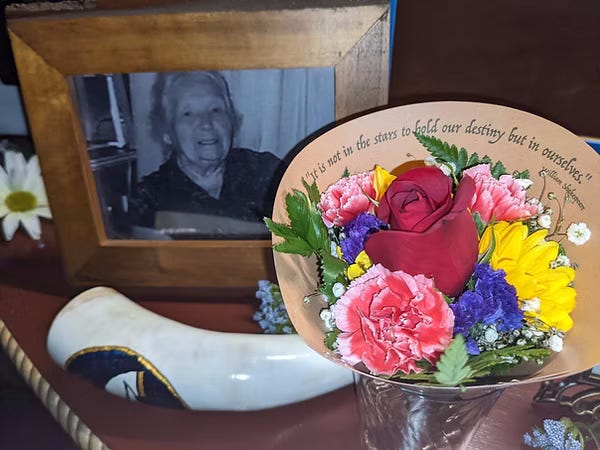
ᛉ September 12, 1913 - May 4, 2005 ᛦ
Many years ago, as we were preparing to honor Else Christensen, I had been noticing how much of what people write about her is based on the Wiki article. Over the last couple of years, the Wiki article has been edited many times with less than favorable tales and false accusations. It seems futile to take on the task of editing it with facts and sources when another round of children will come through to add the lies that they believe. So, I became determined to help with spreading knowledge. I will be sharing what I know of our Folkmother. My information comes from her own voice in interviews, her words in her publication, The Odinist, her close friends that are still with us, and the many prisoners who have shared her written letters with me.
Else Christensen was born in Esbjerg, Denmark in 1913. Although she was baptized Lutheran as a child, she never felt a connection to Christianity. She even went as far as petitioning the government to declare her a non-Christian. She married Alex Aage Christensen in 1937. He was a woodcarver by trade. She worked as a handweaver until she injured her back and then moved on to teaching children and adults with dyslexia.
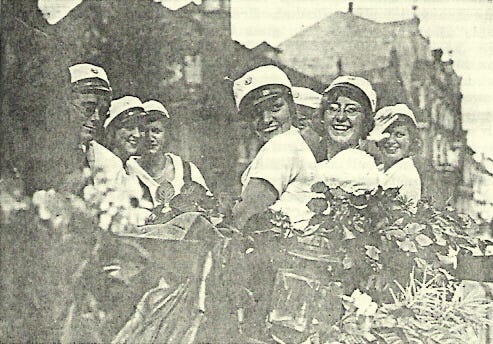
Alex introduced her to Anachro-Syndicalism, which is centered on the idea that power corrupts and any hierarchy that cannot be ethically justified must be dismantled. This caused her to join the Strasserite National Bolshevik faction of the Danish National Socialist Party. To explain this further, basically she agreed with all the ideals of National Socialism except economics and governing. For the most part during the German occupation, they lived very well due to Alex’s woodworking. Since few had his talent, his services were in high demand by the wealthy. With the cash coming in, they could buy whatever they wanted on the black-market, including guns and ammo. However, their allegiance to the Strasserite faction caused them to be under heavy scrutiny, which is why they had several visits by the German police. Since citizens owning weapons was outlawed, this included a visit due to a tip that they had pistols. She cooperated with them and handed over the pistols they asked for so they would not search the house and find other weapons, including a belt-fed machine gun.
Near the end of the war, Else and her husband were called in for questioning due to their political beliefs. She was held for less than 10 hours, and Alex was sent to a concentration camp for six months. The Germans had zero tolerance for any communistic ideals including those in the Strasserite faction of the Danish National Socialist Party. National Socialism was all encompassing and had no room for Bolshevik ideas on governing.
After the war, they bought a large sailboat and had intended to sail to Canada, but the weather did not permit it. They ended up migrating to Canada in 1951. Living in Toronto, she worked as a waitress and struggled to learn the language. Eventually, she worked as an X-ray technician and assistant to the head of the hospital until she retired.
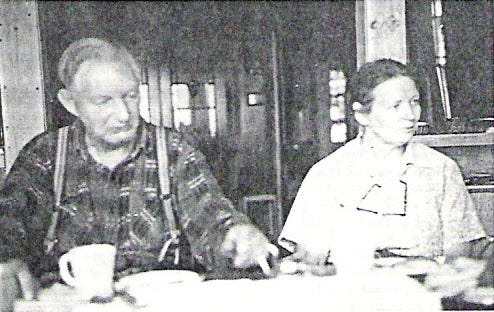
Else recalled being introduced to the writings of Australian Odinist Alexander Rud Mills. She started writing to Alexander Rud Mills until his passing and continued to correspond with his wife, Evelyn Price, until her passing. Else was heavily influenced by his ideas about reviving the worship of the ancient Norse deities. In 1968, Else and her husband started the Odinist Study Group with meetings in their home. A year later, they would form the Odinist Foundation and moved to Crystal River, Florida. She began touring North America to promote Odinism. Then in 1970, the Odinist Fellowship was born. She started reaching out to three prisons in Florida. She recalled that the study groups were small. She was the first to have Odinism recognized by any prison system. While working in the prison, she never had any misconceptions about her purpose. She recognized that most of the prisoners were rotten apples, but she held onto the fact that a small handful would come out and do great things.
She said of her prison work:
No packed rooms in the prison; in each institution I have only a few people; occasionally about a dozen, but 5-6 is more common. I certainly do not want the Fellowship to be a club for cons, or ex-cons; the advantage is that when in prison the inmates have time to discuss and digest what they read, a point that often is lost to people on the outside in the hubbub of daily concerns.
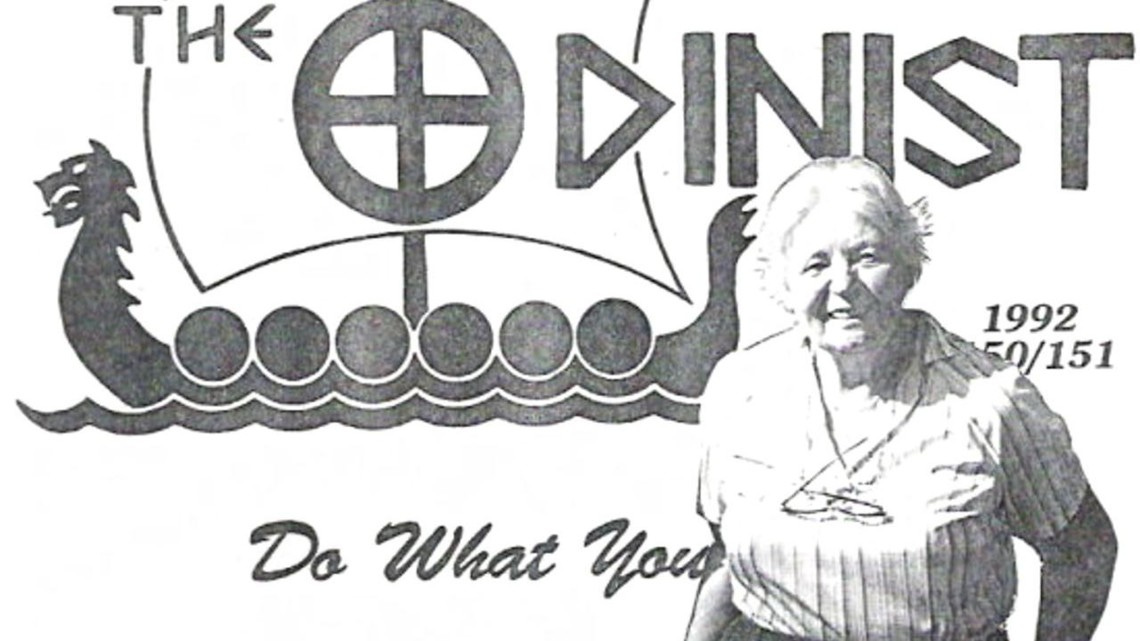
In 1971, the year Alex would pass away, is the same year the first publication of The Odinist was released. This publication took off like wildfire, especially within the prison system. She continued her building of Odinism and published The Odinist up until her death on May 4th, 2005.
On Odinism she said:
To understand my approach to Odinism, one simply has to realize that only when one knows all aspects of an ideology, can one choose wisely; if you only know half of it, you’re out of balance.
She also wrote:
Odinism, to the consternation of many people, Odinists as well as non-Odinists, is not dogmatic. We will have to agree upon and tolerate several main interpretations of Asatru/Odinism. Eventually I believe it will all come together. Although I at present do not deal with rituals and rune lore, I’m certainly aware of both and agree that they are part of our ancient religion. I’m simply not able to deal with them, so I leave them be until somebody appears who can do so in an way I can accept as the closest to ‘the real thing’ when my instincts tell me they are.
Else Christensen was bestowed with the title Folkmother due to her devotion to rebirthing Ásatrú after picking up the torch from Alexander Rud Mills. Most of those who have since come to their re-awakening probably would have not done so had it not been for her. Her dedication to bringing people back to their ancestral roots, especially those in prison, is something that should inspire us all.
One of my favorite quotes from Else is from 1992:
We’re all more or less caught up in the speed trap of modern society. We have just witnessed the Olympics where a fraction of a second makes the difference between a win or a loss. But in life you’re not in competition with anybody but yourself, you’re not out to win medals; you’re here as a member of your Folk, and your efforts are not counted in seconds in competition with other people, but rather in the quiet and continuous influence you have in the overall future in the life of our Folk.
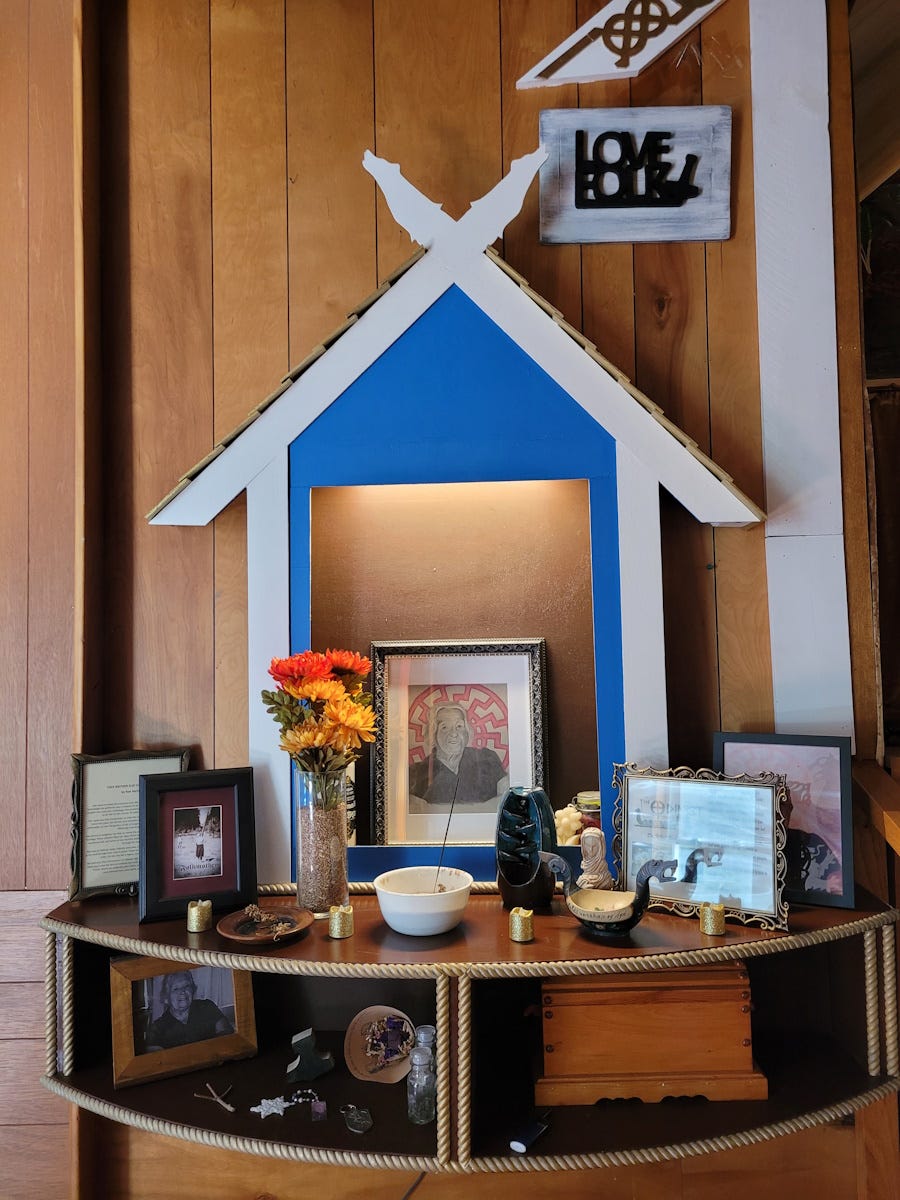
The Asatru Folk Assembly holds a Day of Remembrance for the Folkmother on her birthday, September 12th. There is a memorial altar dedicated to her at Baldrshof, the third Hof of the AFA.
Hail the Folkmother!

Join us next month for another edition of the Runestone Newsletter, and more action from the Assembly! Hail victory!