

Ausa Vatni
Welcoming the child

“Ausa vatni”, from the Old Norse “sprinkle.INF water.DAT”, is the proper name of the Asatru birth ritual. It is colloquially called a “baby-naming”, although neither “birth-ritual” nor “baby-naming” really describe what this ritual is. Simply put, it is the introducing of a baby to the Gods, Ancestors, and religious community. Thus, it is a pronouncement of the child’s name before the community, not a literal attaching of a name to the child.
Practice
An Ausa-vatni involves sprinkling water or mead on the baby’s head, doing a three-rune pull, and then the officiant introducing the child to the folk. The baby is introduced by name: the parents of the child actually name him or her at birth, the goði/gyðja doesn’t get to pick the child’s name, they’re just ritually introducing them to the community. All AFA rituals are legally binding, or more so the AFA only does life-event rituals if they are also legally binding. So, an Ausa-vatni is a presentation and formal introduction of the child by their real, legal, name.
The basic formula of sprinkling a child with hallowed liquid and then formally confirming their name before the community first shows up in an article by Stephen Flowers in 1979’s Spring issue (he had not received his PhD, so he was not Dr. Flowers yet!). However, scholars had been noticing the “Norse baptism” ritual for decades up to that point. The word ON:“ausa”, “to sprinkle”, shows up consistently throughout the literature pertaining to the ritual. One such scholar was actually Stephen McNallen, who performed an Ausa Vatni on 1978’s June 9th, for his son: this is the first recorded Ausa Vatni in the modern period.
The rune-pull is a more recent practice, started by Allsherjargoði Matt Flavel. The three runes aren’t so much an act of divination in the sense of trying to find hidden knowledge, but rather are a tool of direction, given to the child by the priest. They are tools from the Nornir to orient them through their lives. While the officiant formally presents the runes to the child and crowd, it’s actually up to the baby to figure out, and in a sense, enact, those runes throughout their lives. They aren’t so much actual statements of information, but rather tools that the kid needs to figure out the meaning of.
There’s a vague similarity between an ausa vatni and the various forms of HEB:”tevilah” in the Judeo-Christian tradition. However, the core difference is who the ritual is for. In the various schemes of HEB:”tevilah”, the point is ultimately that the immersed/sprinkled individual is washed of ritual impurity and emerges clean with a renewed mission to remain clean. It’s for this reason that Jews and Christians immerse an entrant: total cleansing. HEB:”Tevilah” performed via sprinkling with liquid is a much later innovation, with some academics positing that it actually comes from the Ausa Vatni. This is why infant HEB:”tevilah”s have been, and still are, a thorny issue amongst Abrahamics: can a baby really choose to remain ritually pure?
Here, however, the baby isn’t being cleansed: rather, they are marked as holy, signifying their value to the Gods, ancestors, and Folk. It’s not about cleansing the child (via ritual washing cleansing ritual impurity) as much as it is about declaring them valuable and worthy of love and membership in the community (by putting holy liquid on them, marking them as valuable). So the pageantry of the rite isn’t really for the baby, but rather the crowd, who are essentially silently assenting to caring about this baby and having it as a member of their community. That community includes the Gods and Ancestors, of course, hence the importance of this formal introduction!
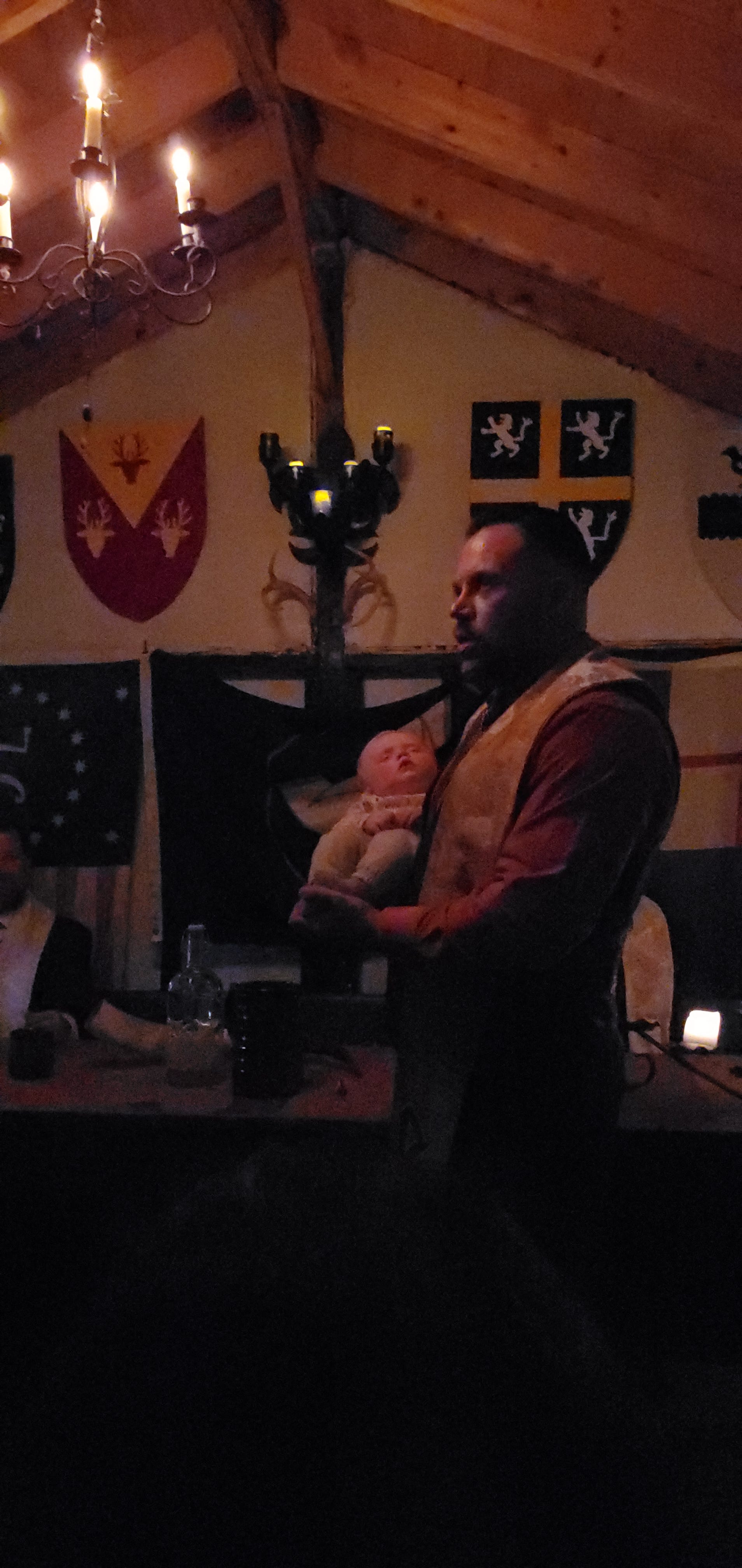
Now then, let’s look at some texts!
First, let’s look at Havamal 158/159
158/159. Þat kann ek it þrettánda:
ef ek skal þegn ungan
verpa vatni á,
mun-at hann falla,
þótt hann í folk komi,
hnígr-a sá halr fyr hjörum.
158/159. This thirteenth I know:
if I am to cast
water on a young thegn,
he shall not fall,
although he joins an army,
that warrior does not bend before blades.
-Bellow’s translation
This is one of the “charms” in the Hávamál. For context, Óðinn is listing things that he can do using runes. It’s a sort of broader metaphor for “things that you can pray for” (I’m eliding over the rune-lore stuff as it’s not relevant to where we’re going). The Allfather is doing a bit of wordplay with this one, as is his wont. What he’s saying is that he can protect his worshipers in battle. The wordplay however is using the metaphor of Ausa Vatni to convey that. The word used for “army” is “folk”, which means both “people” but also “army”. “í folk komi”, “comes to (joins) the folk” (note the accusative) thus means enters manhood, and thus the pool of men who can fight. It also means “enters into the community”. Thus, Óðinn’s protection of warriors is likened to the protection of being an infant who is part of the folk (denoted by having been sprinkled with water).
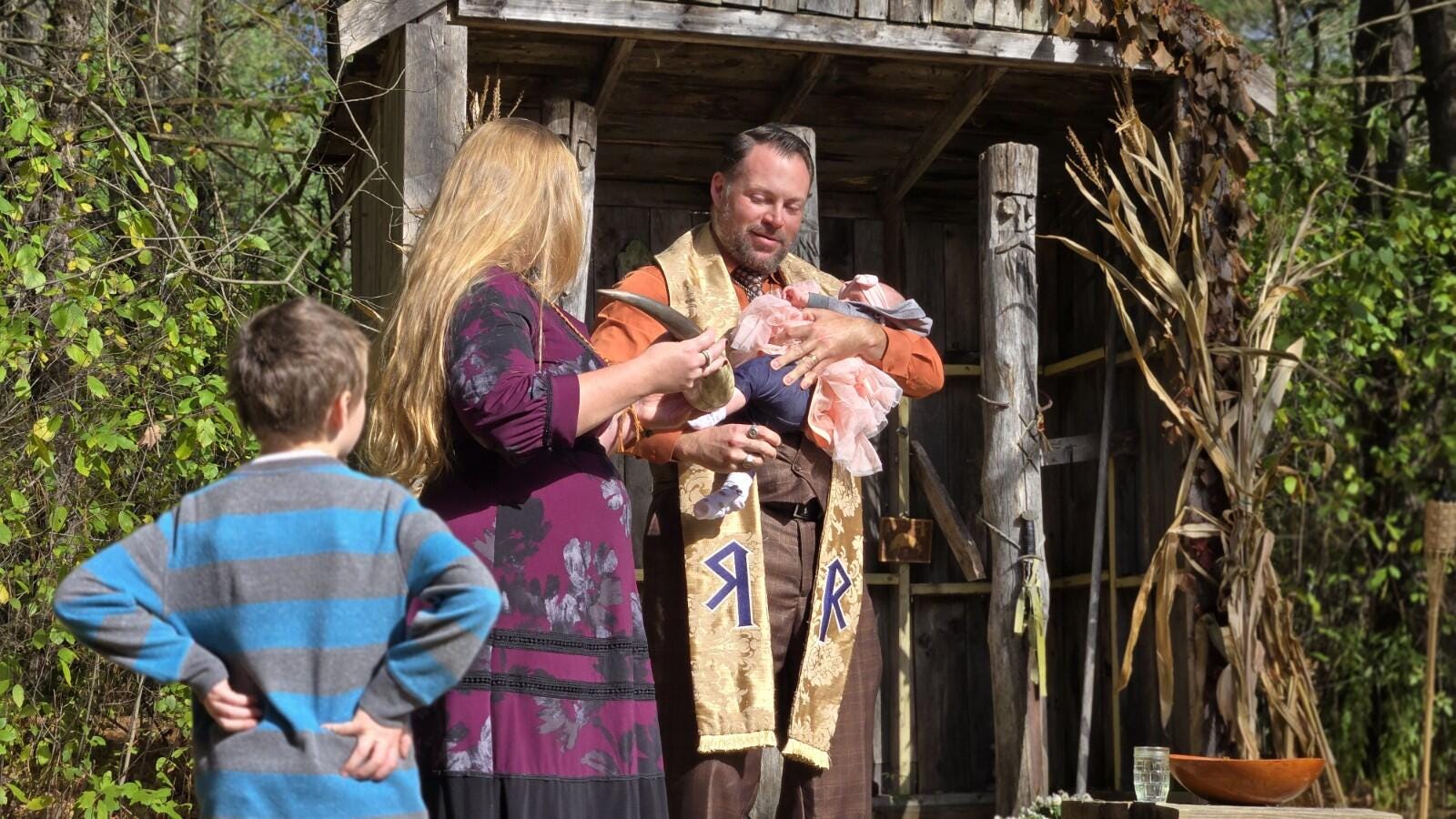
Now we come to Rigsthula 34.
34. Svein ól Móðir, silki vafði,
jósu vatni, Jarl létu heita;
bleikt var hár, bjartir vangar,
ötul váru augu sem yrmlingi34. A son had Mothir, | in silk they wrapped him,
With water they sprinkled him, | Jarl he was;
Blond was his hair, | and bright his cheeks,
Grim as a snake’s | were his glowing eyes.-Bellows’s translation
A bit more blunt, this one! So, part of the “birthing process” involves the child being sprinkled with water. This is describing the birth of a particularly important child, so the sprinkling with water is thus a cultured and civilized practice. Notice that the child is sprinkled with water, and then named. There’s an order here.
Egils saga Skalla-Grímssonar 35
Þóra ól barn um sumarið, og var það mær; var hún vatni ausin og nafn gefið og hét Ásgerður. Bera fékk til konu að gæta meyjarinnar.
Thora bare a child in the summer; it was a girl. She was sprinkled with water, and named Asgerdr. Bera got a woman to look after the girl.
-W. C. Green’s translation.
So, again, just a simple description, but, we once again see that order of SPRINKLE – NAME. There’s some context here that should be added: Bjorn and Thora ran off, knocked boots, and Thora got pregnant. This causes some friction between various people, and Bjorn has to own up to his actions and take care of Thora. This is an important point for what comes next: the Ausa Vatni is a recognition of the child as a person, but also is related to the licitness of the marriage of the parents.
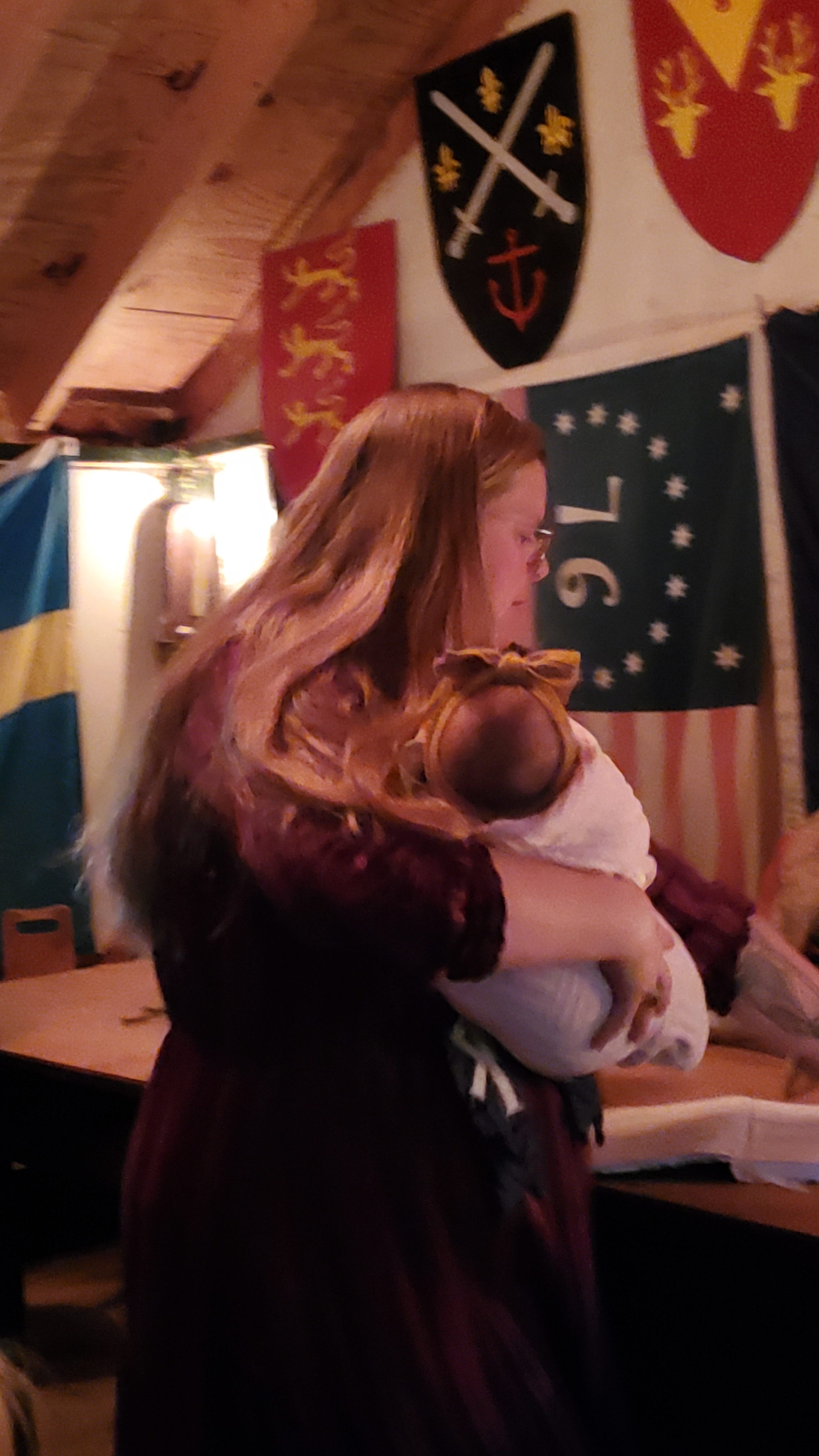
Let’s look into that, in a grimmer attestation: Harðar saga og holmvera. I frontloaded all of the pictures of cute babies because I feel bad putting pictures of actual infants next to this serious stuff.
Harðar sag aog holmvera 8, part 1
Og litlu síðar fékk Signý sótt þá er hún skyldi léttari verða og horfði þar mjög þunglega um sóttarfar hennar. Torfi talaði við hana, kvað sér illa hug sagt hafa um hennar gjaforð, lét sér og mjög hugstætt til Grímkels alla stund verið hafa. Hún kvað eigi ólíklegt að til mikils drægi um. Hún fæddi meybarn bæði mikið og jóðlegt. Torfi vildi eigi láta vatni ausa barnið fyrr en reiddist um líf Signýjar. Hún andaðist þar þegar á sænginni.
Þá gerði Torfi sig svo reiðan að hann vildi láta barnið út bera. Hann bað Sigurð fóstra sinn taka við barninu og fara með það til Reykjadalsár og tortíma því þar. Sigurður kvað þetta allilla gert vera en nennti þó eigi að synja Torfa þessa. Sigurður tók nú við barninu og fór vegar síns. Honum sýndist vænlegt barnið og því nennti hann eigi að kasta því út á ána. Hann snýr nú upp til Signýjarstaða og leggur þar niður barnið í garðshliði og þótti líklegt að það mundi brátt finnast. Grímur bóndi stóð úti undir húsgafli, Signýjarson. Hann sá þetta, gengur til og tekur upp barnið og hefir heim með sér og lætur Helgu konu sína bregðast sjúka og segja hana hafa fædda mey þessa. Hann lét ausa vatni og nefndi Þorbjörgu.
…
Torfi varð reiður við það. Hann tók meyna og nennti eigi að láta drepa hana því að það var morð kallað að drepa börn frá því er þau voru vatni ausin. Hann hefir meyna heim og selur til fósturs ambátt nokkurri og ekki fékk hann henni til klæða og ekki vildi hann taka af verkum ambáttarinnar.
And soon afterwards Signy was taken ill with childbirth labour, and her illness was looking very serious. Torfi spoke to her, said he had never felt happy about her marriage, declared that he had always been very much against Grimkel. She said it was not unlikely that it would have grave consequences. She gave birth to a girl-child, large and healthy. Torfi would not have the child sprinkled with water until Signy’s fate was clear. She died straight away without getting up from childbirth. Then Torfi got so angry that he wanted to have the child exposed to die. He told his foster-brother Sigurd to pick up the child and take it to Reykiardalsa and destroy it there. Sigurd said that was a very bad thing to do, but yet did not care to disobey Torfi in this. Sigurd now picked up the child and went on his way. He thought the child looked pretty and so did not feel like throwing it out into the river. He set off now up to Signyiarstadir and put the child down in the farmyard gateway and felt sure it would soon be found. Farmer Grim was standing out under the gable of the house, Signy’s son. He saw this, went up and picked up the child and took it home with him and made his wife Helga pretend to be ill and say that she had given birth to this girl. He had her sprinkled with water and named her Thorbiorg.
…
Torfi was angry at this. He took the girl and did not feel like having her killed, for it was said to be murder to kill children once they had been sprinkled with water. He took the girl home and gave it for fostering to a certain slave-woman, and provided nothing for its clothing and would not remit any of the slave-woman’s labour.
-Faulkes’s translation
Some context. Signy marries Grimkell, against the will of Torfi, who plots vengeance for this. When Signy gives birth to Grimkell’s child (described above), and then dies, Torfi tries to get rid of the child. But, the man tasked with doing the deed can’t stomach the thought, and gives her instead to a farmer-couple, who raise the child as their own. When Torfi finds out about this (in the second portion), he is upset, and has the child enslaved. The tale takes place in the later 900s, but the sources were composed long after that (the late 1400s), so when this text was written down is after apostasy was forced upon Iceland, but it records events taking place within an Asatru context. There’s some really dumb Christian stuff in this saga, which is in a way black comedy as this saga is about a series of tragedies with multiple lives being ruined, and then hokey Christian nonsense crops up in the middle.
So, the first thing we see is that there’s a dialectic regarding the exposure of infants within the culture of the time. Sigurd is tasked with doing this by his superior, but refuses, and instead gives the child to another family (also attested elsewhere in Scandinavia, and apparently rather common in Greece and Rome). So, these people saw Torfi’s act as heinous (he is consistently shown as a villain in the saga).
I’ve seen people who come from Protestant backgrounds often have a problem wrapping their head around that idea of “a text talking about something bad while not endorsing it”. This is because these people believe iron-age Israel to be a utopia depicted by the Torah, and utopia is achieved by mimicking that depiction. So, the point of a sacred text is to act as an image that we enact upon reality. They then apply this idea to other texts, arguing that we should try to mimick Torfi because he shows up in the story. WhyTorfi and not Sigurd? Because modern American Protestants have trouble squaring the circle of iron-age Israel and silicon-age America being radically different societies, so they instinctively identify with the problem (murdering babies) rather than the solution (not murdering babies).
The second thing we see is that there’s a recognition that killing infants is bad, there’s just a question of when it becomes criminal: that point is the Ausa Vatni (the sprinkling and naming). As an aside, we still sort of humor this idea today: when my daughter was born, she and my wife still bore the blood of birth when the nurses were handing me the birth certificate and paperwork to fill out that would result in me being recognized as legally accepting her as my child and responsibility.
The precise line that we’re given is: “það var morð kallað að drepa börn frá því er þau voru vatni ausin”; “that was murder called to kill some children from when therefore which they were sprinkled via water”. ON:“Morð” is actually cognate with ModE:“Murth”, which is a dialectical variant of “murder” used in Northern England; these two words are related to ModE:“murder”, although that comes to us via a variant form unique to Proto-West-Germanic.
This is actually a technical term. In Germanic law, manslaughter was a socially and legally licit killing. The word ModE:“manslaughter” actually comes to us from OE:“mannsliht”, and as such the ModE:“-slaughter” is totally unrelated to ModE:“slaughter”, which actually comes to us from ON: “slahtr/sláttr” (the Modern English cognate of that word is actually ModE:“slay”). Manslaughter was, as stated, socially and legally licit if one followed the procedure of immediately reporting the killing to everyone nearby (to provide a record of the event). While punishment was still possible, reporting the crime immediately could reduce the punishment to a fine, if there even was one.
If the crime wasn’t reported, or if upon inspection it was found that the perpetrator had attempted to cover up the crime in some way, then that was murder. It’s for this reason why “kill and murder” or “murder and kill” is a phrase in various Germanic countries, as technically murder and killing aren’t the same thing. Cleasby & Vigfusson also attests to some other “dishonorable” acts that result in a killing being murder, namely killing someone in their sleep or by stealth at night.
Now, we’ve digressed a bit, so let’s recap as we move on. In the saga, Torfi is doing this because he’s angry that Signy chose Grimkell and not him. He wants to spite her, and the child, but doesn’t want to get in trouble for it, so he sets about to abandon the child during the legal greyzone during which most infant deaths occurred (the earliest period after birth), and intentionally refuses to recognize it, as that would require him to care for it.
Wait, care for it? Why him? Why not Grimkell? In the saga, Signy wished to travel north to spend time with her family, and along the way stopped at Torfi’s estate to rest. However, Torfi convinces her to stay with him, she stays at Torfi’s for longer than expected, and her maid dies, which greatly aggrieves her, and slows her travels, and then she gives birth (and dies). There’s a portion earlier in the text where Signy has a dream that confirms that she’s pregnant, but there’s a darkly ironic possibility that the child that Torfi wanted to abandon was actually his. But that’s not why Torfi would have been expected to care for the child.
Slight digression
This attitude towards not just infanticide, but killing period, is totally baffling to modern Westerners. A good way of looking at it is in the same vein as people wondering why, when faced with machete wielding nutjobs from Subsaharan Africa in close quarters, the police don’t seemingly “shoot the machete out of the assailant’s hand”. The reality of literally every step and bit of context of the situation is completely unknown to them: people who do know what they’re talking about often have a hard time conveying the reality of the situation because so much of it requires prefacing with extremely basic information.
In Medieval Scandinavia, there was no real executive branch of government becuase there wasn’t really a government. Unless you were on the property of the king, or were important enough for him to have a vested interest in caring about you, the law was based on arbitration between parties, which were clans (in Iceland this was usually just small families) mediated between professional arbitrators (Brehon Law in Ireland is this, and it’s far better attested than other equivalents) subject to regular schedules for settling offenses. This is where weregild and the like comes from. This is because individuals weren’t the basic unit of this society, but rather that clans were: an individual cares very much about getting killed, but for a clan, losing an individual is only as damaging as the loss of that individual’s worth to the clan, much like how losing a horse is only as damaging to a person as the value of that horse to the individual.
Under this model of conflict resolution, the point of “justice” is recompensating a clan for something that has been done to it, not properly enacting bureaucratic dictats as to how individuals are to be managed. This “admit that you committed a crime” behavior comes up because it actually minimizes the punishment to the individual by maximizing clarity to the clan. If the criminal were to lie, they would be minimizing clarity to the clan, and thus make the clan less able to properly engage in arbitration.
So when we bring up infanticide in this context and the Asatru Norse distaste for it, and the legal concerns of it, we have to keep in mind that what is really being discussed here is clans and families and their interactions, not an omnipresent state interacting with individuals. “At what point is infanticide murder” didn’t mean “when do the police get involved”, it meant “at what point does the clan step in and put down one of its own”, or worse, “at what point do the neighbors step in and determine that this person is detrimental if not dangerous and needs to get put odwn”. Keep in mind that these people live in a society that is watched over by a deity that is believed to crush people who mistreat women and children with a divine hammer. Said deity is part of a tribe of deities that look extremely poorly upon people not handling things themselves. At what point do your neighbors, and the Gods, start getting involved because of your misbehavior? This is all wrapped up in a society in which kinslaying is an extremely heinous crime (in fact arguably the most heinous crime that isn’t theological in nature).
Digression over
Let’s recap as we move on. In the saga, Torfi is doing this because he’s angry that Signy chose Grimkell and not him. He wants to spite her, and the child, but doesn’t want to get in trouble for it, so he sets about to abandon the child during the legal greyzone during which most infant deaths occurred (the earliest period after birth), and intentionally refuses to recognize it, as that would require him to care for it.
Wait, care for it? Why him? Why not Grimkell? It’s not like it’s his kid, right? In the saga, Signy wished to travel north to spend time with her family, and along the way stopped at Torfi’s estate to rest. However, Torfi convinces her to stay with him, so she stays at Torfi’s for longer than expected, her maid dies which greatly aggrieves her and slows her travels, and then she gives birth (and dies). There’s a portion earlier in the text where Signy has a dream that confirms that she’s pregnant, but there’s a darkly ironic possibility that the child that Torfi wanted to abandon was actually his (Medieval Scandinavians loved that sort of pitch-black grim humor).
But that’s not why Torfi would have been expected to care for the child.
What IS Ausa Vatni?
The Ausa-vatni is the modern form of an ancient Indo-European ritual: that of a formal declaration of parentage and of raising a child. A father is not merely a biological progenitor, but rather a semisovereign agent who is one of the two heads of a family (which is not just a collection of relative). The father is the top-male of the family. In Rome, the LAT:“PATER FAMILIAS” (lit. ModE:“father family’s”, although LAT:“FAMILIAS” is an archaic genitive, the normal one was LAT:“FAMILIAE”) was priest-king, warrior-lord, and merchant-prince of his small state. This is literal: Anyone under the LAT:“MANVS” (“hand”) of the LAT:“PATER” could be executed by him at will for crimes against his state. The LAT:“PATER FAMILIAS” wielded great power.
He also had great responsibility. Namely, to protect, house, entertain, spiritually guide, and feed everyone who lived on his land. This two-fold responsibility and right of small-statehood gave the LAT:“PATER FAMILIAS” the necessary right and responsibility to control who set foot on his land, and whom he would house protect, and feed. This included infants. A child born unwanted by the father (as in, the owner of the estate, not literally the child’s biological progenitor) would thus be faced (or, more aptly, their mother would be faced) with the prospect of having to go somewhere else. In the ancient Mediterranean world, unwanted children could be given to other families, sold into slavery, or given to what amounts to an orphanage (that would itself often sell children into slavery). Unlucky infants would be subjected to exposure (left in the wilderness to die of causes uncertain to the parents).
Until very recently, this was simply the norm. It continued into the Christian period with no disturbance, where infanticide (either prenatal or postnatal) was upheld as licit and legal in almost every court, secular or otherwise, in Europe for a millennia. Partially, this was due to the constant malnourishment that most humans experienced until recently, and the extremely high rate of infant mortality. “A baby died” was a tragic fact of life that was almost universal: no court could possibly try everyone for it, and the Catholic Church’s stance on it was due to fear of riots if they tried to actually punish people for what was seen in Christianity as simply a natural phenomena.
Obviously, a singular “premodern infant mortality rate” cannot be constructed. However, in the early 1900s, the first concerted efforts to lower infant mortality rates in the US took place. At the start of these efforts, infant mortality rates were 1 in 10 (at the time considered to be fantastically good), and the programs lowered that to 1 in 100.
Killing babies is bad.
-Allsherjargoði Matt Flavel
Thus, for a father to accept a child was not merely accepting a costly burden and future investment, but also required the father to attempt to ensure that the child survive long enough to make a “return” on that investment. Crossculturally, most “infant acceptance” rituals take place well after birth (the Miyamairi ritual in Japan is done 31 (boys) or 33 (girls) days after birth) because until very recently, an infant had a significant chance of dying shortly after birth. The emotional blow that comes from preparing to make that investment, and then the infant dying, is obvious.
This is pure speculation on my part, but I almost imagine that this suite of Indo-European attitudes towards naming children and accepting them into the family came about precisely because killing babies is bad. Kinslaying is already the single worst thing that one can commit, more so if that kin is your infant child. At a time of such terribly high infant mortality, the “dehumanization” of the unnamed child is necessary to prevent the death of an unnamed infant being murder if it occurred due to, say, starvation, premature birth, disease, etc. Today, a child born before 22-weeks almost certainly cannot survive without complex medical intervention. If that premature child were to die, through no fault of the parents who had no ability to prevent the death, should it still be a crime? No, really, should a 12th-century peasant couple be prosecuted in a court of law because their child was born prematurely some 800-years before the invention of the medical technology necessary to keep that child alive?
There is little evidence of exposure of infants in the Germanic world: only four bodies of children (not infants) have ever been found simply “loose in the woods”. All bodies of infants uncovered in the Germanic world seem to have been subjected to some kind of funerary right, such as the lavish child-burials of Birka, or keeping urns of bones and ashes (premodern cremation left bones in the ashes) in the home. Today, infanticide has become a political football to kick around (Þórr’s banjo what a grim statement), and that gets people wrapped up in “OWNing the [other side] for INTERNET POINTS” more often than sober analyses of premodern child mortality. Disease and malnutrition (if not outright starvation) were a grim reality the loomed over every parent’s head.
In the West, we parents should remember that in our ancestors’ eyes, we live an extremely luxurious lifestyle for not having to worry about a 1/10 chance that your child simply catches pneumonia out of nowhere and dies for no reason. The fact that we even have the option to take the kid a sick child to a doctor is an enormous difference between today and how most people lived just 100 years ago.
Closing
Thus the importance and gravity of the Ausa Vatni, which is a modern oath to raise a child, presenting them before the Gods, the Ancestors, and the Folk as a person, and asking to be held to doing that. Spiritually, the Ausa Vatni is a ritual bestowing of the “final part” of the Soul-Complex: the name. The naming before the community recognizes that the infant bears an Aryan soul, and that if not taken care of, that Aryan infant will die, and the community shall hold the parents accountable.
In the past, people had to make tough decisions about who lived and who died. In the past, the line between survival and starvation was razor thin. In the past, we could not be sure that any given child would survive birth. Today, we are very fortunate that the vast majority of infants survive, and live long enough to be named. We should be extremely thankful for the Herculean efforts that our Aryan ancestors made to bring that about. Today, that oath that we make to our Gods, our Ancestors, our Folk, and our children, is no less important now that we are farther from misfortune than our ancestors were. In fact, it is more important. Having a child is such a glorious blessing. It is also such a glorious blessing upon the world to be able to have happy, healthy, hale, whole, and hearty White babies. This is a precious treasure that we must never lose.
-Folkbuilder Christopher Savich
For more about the Ásatrú Folk Assembly, visit our website!
Thanks for reading the Runestone Newsletter! Subscribe, share, and donate to help bring the Folk home.